




19th May 2026
You’ve noticed a learner struggling to keep up, but you’re not sure why. Is it the pace? Is it the way you’re teaching? Is it something else entirely? In our ‘Inclusive Teaching for Learners with SEN’ series, we’re exploring how to build truly inclusive classrooms. This post focuses on cognition and learning needs – how to spot them, understand them, and respond with strategies that actually work. We’ll walk through real classroom examples so you can see exactly what this looks like in practice.
Understanding Cognition and Learning Needs
You’ve differentiated your lesson. You’ve broken it into small steps. You’ve used visuals, Makaton, and manipulatives. Yet one learner still isn’t grasping the concept at the same pace as their peers. This is what cognition and learning needs can look like, and the term refers to the cognitive processes involved in acquiring knowledge – thinking, memory, processing speed, and attention.
This means:
- They may learn at a slower pace than their peers, even with appropriate differentiation and adaptive practice.
- For example, a learner might need three weeks to grasp a concept their peers understood in one week – and that’s okay.
- They may struggle with specific aspects of learning, such as reading, writing, or maths.
- A child might be brilliant at science, but find phonics genuinely difficult.
- They may have difficulties with working memory, making it harder to follow instructions or retain information.
- A learner might forget your instruction by the time they have sat back down.
This doesn’t mean a learner isn’t capable. It means they need a different approach.
Key Areas of Difficulty
As teachers, we often see the behaviour, but we need to dig deeper. What’s actually happening? Is it that they can’t remember? Can’t process auditory information quickly enough? Can’t organise their thinking? Understanding the ‘why’ changes how we respond.
Memory and Retrieval
Some learners’ brains struggle to store information or pull it back out when needed. They might understand something in the moment but can’t remember it tomorrow. Or they can’t hold multiple pieces of information in their head at once.
Some learners may struggle with working memory, which is our mental ‘sticky note’. It allows us to hold on to new information so the brain can briefly work with it to accomplish the task.
What you might see:
- Forgetting instructions by the time they sit down
- Can’t recall what they learned yesterday
- Struggling to follow multi-step instructions
- Loses track of what they are doing mid-task
How to support:
- Using visual supports – picture sequences, written instructions, work examples
- Break tasks into single steps and manageable chunks
- Repeat key information
- Use consistent routines so learning becomes habitual
Information Processing
Some learner’s brains take longer to absorb, understand and respond to information. This involves how the brain receives, interprets, and acts upon sensory input.
What you might see:
- Takes longer to respond to questions
- Seems confused by complex instructions
- Struggles when information comes too fast
- Needs time to ‘process’ before answering
How to support:
- Slow down your pace and simplify instructions (first …, then ….)
- Give additional processing/wait time (count to 10 before expecting an answer)
- Present information one piece at a time
- Use visuals and Makaton alongside verbal instructions
Executive Function
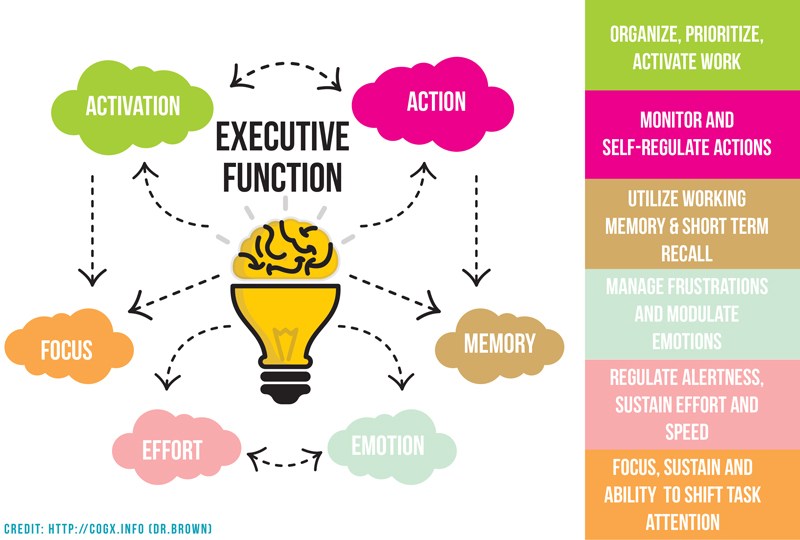
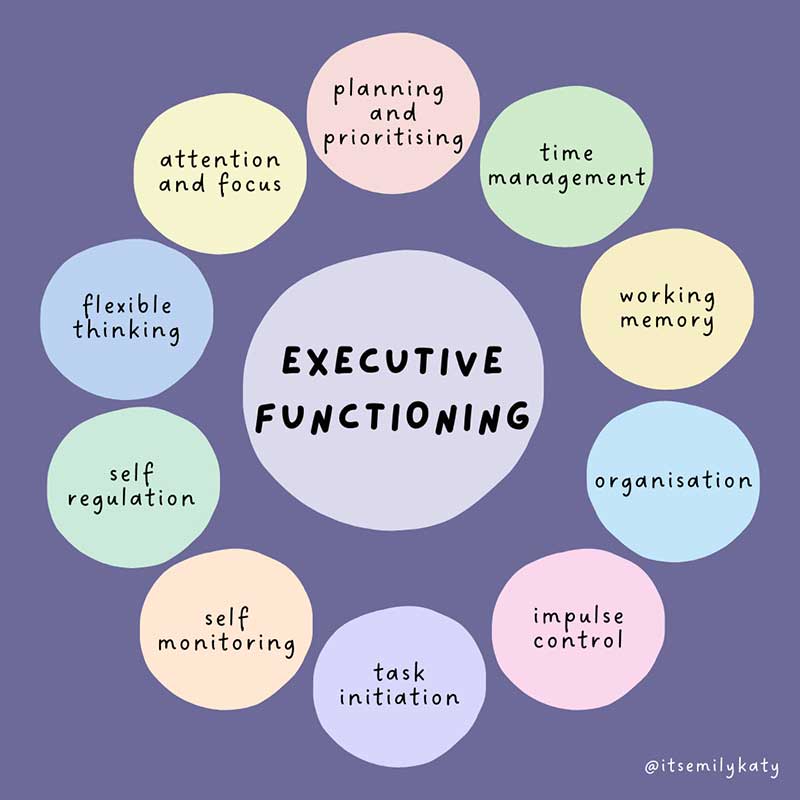
This is the brain’s management system or ‘air traffic control’ – planning, organising, starting tasks, switching between activities, and managing time. When this is difficult, learners know what to do but can’t organise themselves to do it.
What you might see:
- Can’t start a task even when they understand it
- Struggles to organise materials or thoughts
- Difficulty switching between activities
- Can’t break a big task into steps
- Loses track of what comes next
How to support:
- Provide visual step-by-step guides
- Use checklists and visual schedules
- Break tasks into smaller chunks
- Offer external structure (timer, organisers, buddy support)
Common Specific Learning Difficulties
Dyslexia
Dyslexia is a lifelong condition that affects the ability to process and remember information, extending well beyond just accurate and fluent word reading and spelling. It affects people to different degrees, often impacting working memory, auditory and visual processing, and executive function.
It is not linked to intelligence. In fact, children with dyslexia often have strong visual, creative and problem-solving skills. It often occurs with related conditions as DCD (Developmental Coordination Disorder) and ADD (Attention Deficit Disorder).
Dyscalculia
Children with dyscalculia have difficulty understanding numbers, hindering process in mathematics. Dyscalculia often occurs with other conditions like dyslexia, dyspraxia or ADHD/ADD.
Children with dyscalculia may:
- Have difficulty when counting backwards
- Have poor sense of number and estimation
- Have difficulty remembering ‘basic’ facts, despite many hours of practice.
- Be slower to perform calculations.
- Have high levels of mathematics anxiety.
- Have weak mental arithmetic skills.
- Avoid tasks that are perceived as difficult and likely to result in a wrong answer.
Development Coordination Disorder (DCD) or Dyspraxia
DCD or dyspraxia affects the development of motor skills and coordination. Some children with dyspraxia may only exhibit a few of these symptoms and it may be difficult to identify as all children develop at their own pace.
Signs of dyspraxia include:
- Late to reach motor milestones e.g. sitting, crawling, walking, speaking
- Difficulty running, jumping, hopping, catching and throwing a ball compared to their peers
- Slow and hesitant in most actions
- Trips and falls frequently
- Poor pencil grip
- Doesn’t learn things instinctively and needs to be taught physical skills
- Difficulty keeping friends and judging how to behave in company
- Often anxious and with low self-esteem
- Difficulty following instructions
- Poorly organised and often loses things
Dysgraphia
Dysgraphia is a condition that affect a learner’s ability to recognise and decipher written words, and the relationship between letter forms and the sounds they make.
Learners with dysgraphia may also:
- Have unclear, irregular, or inconsistent handwriting
- Write very slowly
- Have inconsistent letter and word spacing
- Have unusual grip while writing
- Spell incorrectly
Supporting Cognition and Learning Needs
Practical Strategies: Real Classroom Examples
Scenario 1: Supporting memory and retrieval
The context: You have identified a learner who is struggling to participate during guided reading and isn’t able to answer simple questions.
The scenario: You’ve just finished reading a beloved story together. During the follow-up discussion, you ask a simple recall question ‘Who is the main character?’ A few hands shoot up immediately, but you notice one child looks away and fidgets with his uniform. When you gently prompt him, he shrugs. Later, during independent work, he can’t remember the story-writing frame you demonstrated just 10 minutes earlier, even though he was watching and listening. His working memory struggles aren’t about paying attention – he was focusing. It is about holding and accessing information in the moment.
How to support:
- Anchor charts with visual reminders: create a large, colourful chart showing the main character, key events, and story details with simple drawings. Before independent work, point to it ‘remember, our chart is here to help us’. This external memory support means he doesn’t have to hold everything in his head.
- Chunked instructions with visual sequences: instead of giving three steps at once, give one instruction, wait for him to begin, then give the next. Pair each instruction with a Makaton action or visual card that stays visible throughout the task.
- Repetition with slight variation: Build in daily 2-minute ‘story recall’ routines where you retell the same story in slightly different ways across a few days. This spaced repetition strengthens retrieval without feeling like drilling.
- Personal connection: Ask the child specific questions that will prompt personal memories. Personal memories are easier to retrieve, and his answer becomes his own ‘anchor’ for the story content. You could encourage this with a simple ‘think about a time when…’
- Access to reference materials: Keep a simple story board (3-4 pictures from the story) on the learner’s table. Teach him to use it independently: ‘When you need to remember, look at your story board.’
Scenario 2: Supporting information processing
The context: You notice one of your learners is struggling during transitions and not following group instructions.
The scenario: Your class is moving from carpet time to table time. You give clear instructions: ‘Please put the blocks away, wash your hands, then go to the writing table.’ You watch as most children move purposefully. But one child seems frozen. She remains sitting, seemingly not noticing the movement around her. She’s not being difficult or inattentive – she heard you, but processing the multi-step sequence, understanding what each word means in context, and planning her movements in that order feels overwhelming. She needs time and support to make sense of what’s being asked.
How to support:
- One instruction at a time: Resist the urge to be efficient with language. Instead of giving three steps, say: “Please put the blocks in the basket." Pause. Watch her do it. Then: "Now wash your hands." This isn't repetitive – it's responsive to her processing speed.
- Paired written/visual instructions: At the carpet, show a small visual sequence card (3 pictures: blocks → basket, hands under water, child at table) as you speak. This means she can see the steps even after the words fade. Laminate these and keep them for transitions.
- Buddy system with a peer model: Partner her with a classmate during transitions. She watches her buddy's actions, which gives her a model to follow. Over time, she'll manage the sequence independently.
- Reduce background noise and distractions during instructions: When you're giving transition instructions, pause the music, stop side conversations momentarily. Her brain is working harder to process language so competing sounds make it nearly impossible.
- Build in processing wait time: After you give an instruction, count silently to five. Don't repeat immediately. She needs that thinking time.
Scenario 3: Supporting executive function
The context: You notice that a learner needs support during independent or small group time. They struggle to stay on task and end up on their own path, not completing the activity and doing something else instead.
The scenario: You’ve set up rotation stations for phonics practice. Your learners are expected to use magnetic letters, whiteboards, frame boards, and paper to practice writing words or drawing pictures. One child starts enthusiastically. He writes two words on his whiteboard, then notices the magnetic letters. He starts building a tower with them. A few minutes later, you redirect him back to the task. He writes one more word and then starts to look out the window instead. He’s not being lazy or defiant. His executive function skills – planning, organising, initiating work, sustaining focus, and managing transitions between tasks – are still developing and need direct support.
How to support:
- Simplified, visual task lists with one step at a time approach: Create a checklist with just two steps per station: (1) Write your CVC word. (2) Make it with letters. Once he completes and ticks those, move to the next card. Each card is its own small success.
- Colour coded materials: Put the writing materials in one labelled container (red), the magnetic letters in another (blue), the drawing paper in another (yellow). He doesn't have to remember the sequence, he just follows the colours.
- A timer for focus periods: "We're going to work on the red container for 5 minutes. When the timer beeps, we can look at the next one." This removes the decision-making and provides a clear endpoint.
- Adult proximity and quick check-ins: Rather than waiting for him to ask for help, sit nearby. Every 2-3 minutes, glance and offer encouragement: "I see you've finished the CVC words! What's next?" This gentle prompt prevents him from getting lost.
- Celebrate effort and specific progress: "You remembered to get your red container and started writing your word without me reminding you. That's executive function growing!"
Learning Differently
Throughout our series, we’re understanding that some children learn differently. Some learn at a different pace. Some struggle with one specific skill while excelling at others.
When you understand what’s actually difficult for a learner, everything shifts. You stop seeing ‘a struggling learner’ and start seeing ‘a learner who needs more processing time’ or ‘a learner whose working memory needs support.’ That clarity changes everything.
We can't speed up a child's processing or magically expand their working memory. But we can remove the barriers that make learning harder. We can externalise memory with visuals. We can slow down and give processing time. We can break tasks into manageable chunks. These aren't fancy interventions – they're just responsive teaching. And when we implement them, we see our learners make real progress. Not because they 'got better,' but because we finally gave them what they needed to access learning. That's inclusive teaching in action.
More from Amy's Inclusive Teaching series
Introduction to Inclusive Education for Learners with SEN
Identifying and Supporting SEN in the Classroom
How to Support SEN – Communication and Interaction Needs
How to Support SEN – Understanding Sensory Needs
Supporting Learners with Social, Emotional and Mental Health Needs