




30th April 2026
In our ‘Inclusive Teaching for Learners with SEN’ series, we’re exploring how to build truly inclusive classrooms, and more importantly, how to spot what learners actually need and give it to them.
This post focuses on communication and interaction needs, how to identify learners who may need support, and the practical strategies that work – complete with real classroom examples.
Understanding Speech, Language and Communication Needs (SLCN)
Difficulties with speech, language, and communication can be persistent or transitory. Some learners have delayed speech and language development, acquiring communication skills at a slower rate than their peers. Early intervention and support can improve speech, language, and communication for some children but for others the difficulty will persist throughout life.
Learners with speech, language and communication needs (SLCN) find it hard to communicate with others – and the reasons vary widely. It might be that they find it hard to say what they want, or others don’t understand them. They might not understand what’s being said to them, or they miss the unwritten social rules of conversation.
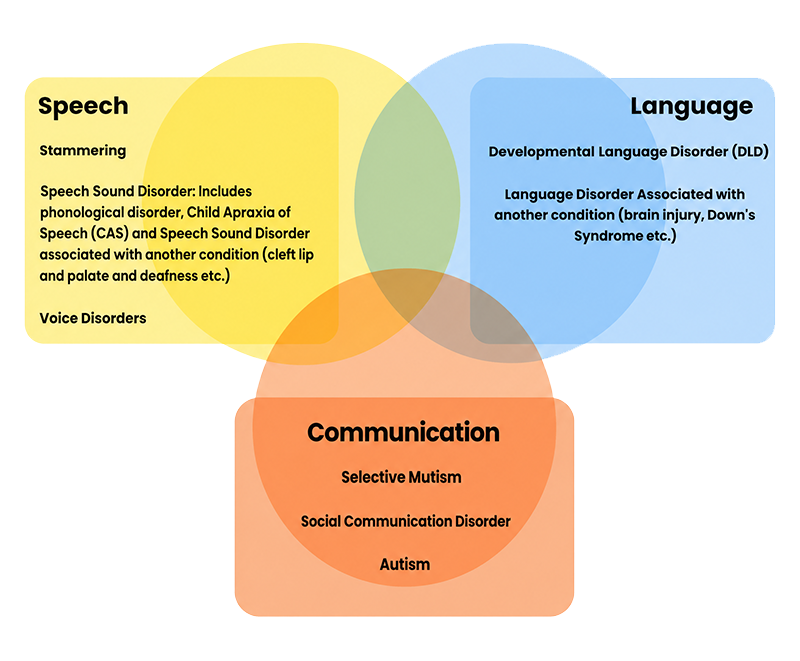
Common Causes of SLCN
Speech, language, and communication needs can be the result of:
- Developmental conditions or speech impairment disorders, difficulties with articulation (for example a cleft palate), a lack of fluency (for example stammering) and voice disorders
- Physical injury or disability
- Hearing loss
- Cerebral Palsy, Down’s Syndrome or Autistic Spectrum Conditions (ASC), including Asperger’s Syndrome or ADHD
Social disadvantage also plays a part. More than half of children in socially deprived areas start school with impoverished speech, language, and communication skills.
Why Strong Early Communication Matters
If we don’t understand why SLCN matters, we won’t prioritise it – and it becomes difficult for us to advocate to parents and colleagues to prioritise it too. The following data, used by Public Health England, shows exactly why we should prioritise it and is helpful in facilitating conversations with families, colleagues, and other stakeholders to advocate for appropriate supports and changes to practice. Although the statistics are UK-based, they offer an insight into the fact that many aspects of a child’s life are impacted by SLCN.
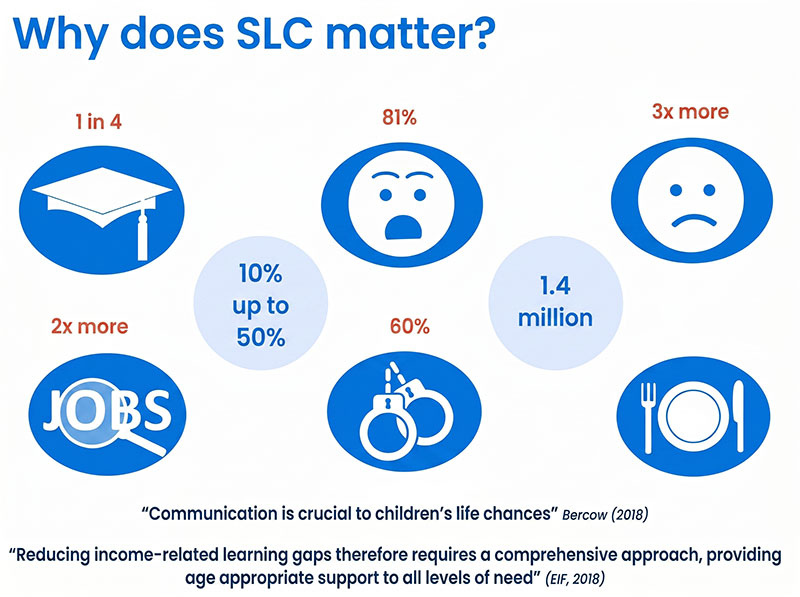
- The number of words a child has on school entry is predictive of the number of GCSEs a child will attain
- 1 in 4 children who struggled with language at the age of 5 did not reach the expected standard in English at the end of primary school.
- 81% of children with emotional and behavioural disorders have unidentified language needs (Hollo et al, 2014).
- Children with vocabulary difficulties at age 5 are three times as likely to have mental health problems in adulthood (Law et al, 2018).
- Children with poor vocabulary skills at age 5 are twice as likely to be unemployed when they reach adulthood (Law et al, 2009).
Supporting Communication and Interaction Needs
Practical Strategies: Real Classroom Examples
Scenario 1: Supporting Speech Sound Difficulties
The context: You have identified a learner who may be having difficulties in communication and interaction. You can see that they are having difficulty with saying what they want to say.
The Scenario: A child in your class loves playing but struggles with speech sound clarity. When he tries to say ‘sun’, it comes out as ‘tun’. During circle time, he becomes frustrated when others don’t understand his words. He stops trying to contribute altogether. You notice he’s withdrawing from group activities, pointing instead of speaking. You want to build his confidence while helping peers understand him.
How to support:
- You create a multi-sensory sound-play station where the child and interested peers explore sounds through play rather than correction.
- Use mirrors so he can see mouth positions, bubbles for sustained breath control, and textured objects to explore with his mouth.
- During circle time, use visual supports – a simple picture communication board where he can point to support his speech, reducing pressure to articulate perfectly.
- Model language back to him naturally (“You want the sun?” while pointing to the picture) without correcting.
- Pair the children with a patient peer buddy during activities; brief the buddy: “When your friend talks, it might sound different, but he has great ideas – ask him to show you if you’re not sure.”
- Use hand puppets or action songs where sounds are exaggerated and celebratory (perfect for practising without feeling singled out.
Scenario 2: Supporting Transitions and ASC Traits
The context: You have identified a learner who may be having difficulties in communication and interaction, and you recognize some traits of Autism Spectrum Condition. You can see she is struggling with transitions.
The Scenario: A child in your class is bright and engages well in one-to-one tasks, but transitions between activities triggers shutdown. When you say, ‘tidy up, time for maths’, she freezes or becomes upset. During group work, she struggles to understand unwritten social rules – she interrupts without realising and becomes distressed by unexpected changes. You want her to feel safe while building her social communication skills.
How to support:
You implement a visual timetable with transition warnings. Use photos of actual classroom spaces and activities so she sees exactly what’s coming.
- Five minutes before transition, use a gentle alert: ‘In five minutes, we’ll pack away. Then we have maths’.
- During group work, use social scripts and visual reminders: a turn taking chart, so she understands who speaks when.
- Teach the unwritten rule explicitly: “When we’re learning together, we take turns to speak and listen to each other.”
- Use a calm corner with her preferred sensory items where she can regulate.
- Create a ‘changes’ visual showing today’s changes in advance, with a photo or simple drawing – this turns unpredictability into manageable information.
Scenario 3: When Speech Needs Impact Literacy
The context: You have identified a learner whose speech and language needs are impacting his literacy development.
The scenario: His ideas are complex, but his sentences are short and grammatically simple. He knows answers during discussions but struggles to explain his thinking aloud. He’s beginning to notice the difference; he avoids answering questions in class and his writing is significantly behind peers despite good comprehension. He’s becoming reluctant to complete literacy tasks.
How to support:
- You use scaffolded sentence stems during discussions so he can build confidence with more complex language: “I think…because…” or “This character felt…when…because”. Display these visibly and practice them together so they come naturally.
- During literacy tasks, employ talk-before-writing: the child speaks his idea to you or a peer, you expand and model the language back. Then he writes or you scribe while he watches, so he sees his ideas translated into text.
- Break writing into small, supported chunks: first, create a visual plan together; then write one sentence together with his input; then he writes the next independently with support nearby.
- Use multimodal forms of expression – sometimes he can draw and label, or create a comic strip, or record audio instead of writing – all valuable literacy expressions.
- During group reading, pair the child with a patient buddy for partner reading where you’ve pre-taught vocabulary with pictures and actions so he understands and can participate.
- Celebrate his ideas explicitly: “…has noticed something important – listen, everyone”. This shifts peer perception from thinking the child ‘struggles’ to the child has good ideas.
Listening Differently
Here’s what we know: communication challenges aren’t deficits to just ignore. They can be the single biggest predictor of a child’s life outcomes.
Every child in your classroom has something to say. Some of them just need us to listen differently. When you notice a learner struggling with communication and interaction, you are not looking at a ‘problem to fix’, you are spotting an opportunity to build a deeper connection and be the adult who finally understands them. That changes everything. For them, and for you.
More from Amy's Inclusive Teaching series
Introduction to Inclusive Education for Learners with SEN