




8th April 2026
In our ‘Inclusive Teaching for Learners with SEN’ series, we are exploring how to support our diverse communities of learners, how to build an inclusive classroom, and how to identify potential needs. Most importantly, we are equipping ourselves with practical and tangible strategies to cater for those needs.
This second post will look at developing a clearer understanding of how to identify special educational needs (SEN) and how to support these diverse needs in our classrooms.
It is important to acknowledge that there is so much to know about SEN that it is unreasonable to expect teachers to become experts in every aspect of such a broad and varied field.
It is also not our job to ‘diagnose’ a child with SEN, rather understand the holistic child; build a rich picture of their interests, their strengths, their emerging skills, and the areas of development where they need support.
How to Identify Special Educational Needs
The Four Broad Areas of SEN
The SEND Code of Practice groups needs into four broad areas to support schools in planning the provision they offer.
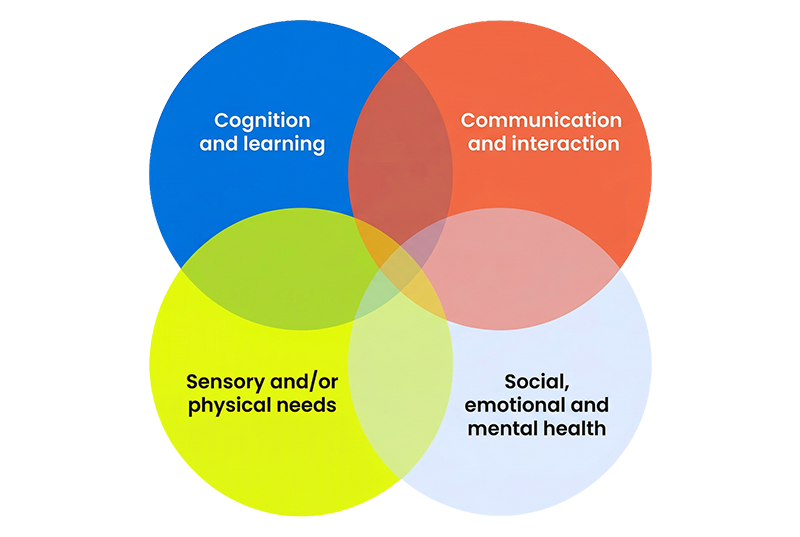
Considering these primary needs is a useful first step, but a more detailed understanding of an individual is required for our actions to be impactful.
There are wide variations within each of these four categories. For example, you may have two learners who both have needs related to communication and interaction, but those needs will be individual to that child; one might have difficulty producing or understanding the sounds of spoken language while the other might struggle to understand the conventions of social interaction, such as turn taking in conversations.
In some cases, difficulties in one area will lead to difficulties in another. For example, a learner with Speech, Language and Communication needs may also present with literacy learning difficulties.
1. Cognition and learning
Learners with this type of need learn at a slower pace than others or have a specific difficulty affecting one area of learning like literacy or numeracy. They may:
- Have difficulty understanding parts of the curriculum
- Have difficulty with organisation
- Have poor memory skills
The range and severity of learning difficulties varies:
- Moderate learning difficulties (MLD) – targeted support in specific areas
- Severe learning difficulties (SLD) – need support across the curriculum, plus help with mobility or communication
- Profound and multiple learning difficulties (PMLD) – complex learning difficulties combined with physical or sensory needs
- Specific learning difficulties (SpLD) – affect one area of learning (e.g. dyslexia, dyscalculia, dyspraxia)
2. Communication and interaction
Learners with speech, language and communication needs (SLCN) find it hard to communicate with others. This may be because they have:
- Difficulty saying what they want to say
- Difficulty being understood
- Difficulty understanding what is being said to them
- Difficulty understanding and applying social rules of communication
Autism Spectrum Condition (ASC)
Autism is a spectrum condition, meaning that it affects people to different degrees in different ways. ASC is the source of a range of speech, language, and communication needs. The condition can also make it difficult when learning to interact socially. Some learners on the autistic spectrum may not speak while others may appear eloquent but understand language in a very literal manner.
They may find it difficult to use or understand:
- Facial expressions
- Tone of voice
- Jokes and sarcasm
They may exhibit:
- Hypersensitivity
- Socially ‘inappropriate’ behaviour
- A preference for being alone
- Repetitive behaviours or routines
- Highly focused interests
3. Social, emotional, and mental health
Every child deserves the best possible start in life and the support that enables them to fulfil their potential. A secure, safe, and happy childhood is important in its own right.
A child’s emotional health and wellbeing influences their cognitive development and learning as well as their physical and social health in their mental wellbeing in adulthood.
Learners can suffer from a variety of social and emotional difficulties, mental health issues or poor wellbeing and social, emotional and mental health (SEMH) including:
- Anxiety or depression
- Mental disorders
- Attention deficit disorder (ADD) or attention deficit hyperactive disorder (ADHD)
- Attachment disorder
4. Sensory and physical needs
The physical and sensory area of needs includes learners with:
- A visual impairment
- Hearing impairments
- Multi-sensory impairment
- Physical disability
- Sensory processing challenges
Moving Beyond Diagnosis and Classification
This model of SEN is designed to shift our focus from a condition or diagnosis that a learner might have to their individual learning needs. The key question is not, ‘What is most effective for pupils with dyslexia?’ The key question becomes ‘What does this individual pupil need in order to thrive?’
Effective Identification vs. Labelling
As educators, it is crucial that the process of identifying SEN and advocating for support is done mindfully.
Every child is unique, and the implication of a SEN diagnosis can vary depending on the specific needs and circumstances of the child.
Identification of SEN:
- Has implications for the support schools put in place for children and the action they take, for example additional resources, specialised teaching strategies, or individualised learning plans
- Increases understanding of the child’s needs, which can then be addressed more effectively
- Can lead to early intervention, which is crucial for the child’s development and learning
- Can provide legal rights to certain accommodations and services in the educational system
However, research also highlights the unwanted, negative effects of labelling.
‘A label of SEN can be a burden for children, diminishing self-esteem. In addition, labels may be used inaccurately, and blanket application may mask individual differences between children, preventing them from being understood in the way that is unique to them.’ (Ofsted, 2001)
Instead, the purpose of identifying a need is to determine what actions we can take as educators and how we address the barriers to learning.
A Note for Teachers Supporting EAL Learners
Identifying and assessing SEN for learners whose first language is not English requires particular care. Educators should look carefully at all aspects of a learner’s performance in different areas of learning and development or subjects to establish whether the lack of progress is due to limitations in their command of English or if it arises from SEN or disability. Difficulties related solely to limitations in English as an additional language are not SEN.
Having a different linguistic background is not SEN but the stage of language acquisition can mask a special educational need. Communication, language and literacy impact progress across the curriculum and progress may appear to be slower than expected in any or all areas of learning. Slow progress may be blamed on the linguistic background when the child actually has another area of need.
Educators can assess SEN effectively by:
- Assessing SEN in the home language
- Seeking the opinion of parents
- Ensuring assessments do not focus or rely on language, for example, by including practical activities, maths, pattern or colour recognition
- Monitoring progress across the areas of learning closely to see if progress improves as language is acquired
Practical Strategies for Supporting Needs
Adaptive Teaching in Action: Real Classroom Examples
You have identified a learner who may be having difficulties in cognition and learning. You can see that they are having difficulty understanding parts of the curriculum.
The Maths Station Confusion
The Scenario:
You’ve set up a maths carousel with four stations focusing on number recognition. You notice one of your learners moving quickly between stations without engaging meaningfully. She picks up objects, puts them down and moves on. When you ask her to show you ‘3 apples’, she looks confused and grabs a random handful.
Rather than assuming the learner is not ready for number concepts, you adjust your approach. You reduce the cognitive load by focusing on just one number (let’s say 2) for a full week.
You use multi-sensory learning: she touches two objects, says ‘two’ and places them in a basket. You add movement: two claps, two jumps, two steps.
You repeat the same routine daily, so the pattern becomes familiar.
You also collaborate with her family, sending home a simple activity (finding two shoes, finding two socks) so learning is reinforced at home.
Within two weeks, she confidently identifies and creates groups of two. You then introduce three.
You have identified a learner who may be having difficulties in communication and interaction. You can see that they are having difficulty saying what they want to say.
The Reluctant Presenter
The Scenario:
During show-and-tell, one learner freezes when it’s his turn to speak. He has something to share but can’t organise his thoughts into sentences. He mumbles, trails off, and sits down quickly, looking embarrassed.
You provide a simple framework: ‘This is a ___. I like it because ____.’
You let him practice with you first (one-to-one) before the group.
You accept shorter responses: a sentence or two is a win.
You use visual aids: he can show the object and point rather than explain everything verbally. You can model the language for him.
You celebrate effort: ‘You told us about your toy – great speaking!’ This builds confidence for next time.
The Assess – Plan – Do – Review Cycle
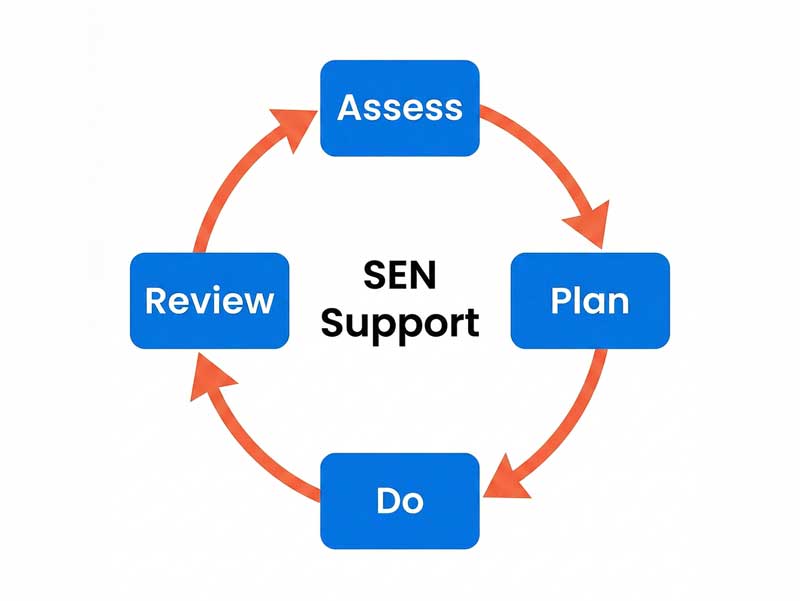
SEN support should build upon the already existing high quality teaching, which has been differentiated and personalised for each individual child. Then it is important to monitor the progress and development of the child. It should adopt a graduated approach with four stages of action: assess, plan, do, and review.
Assess
- Bring together all the information about the child
- Discuss with the child’s family
- Analyse the child’s needs
- Determine if more specialist expertise is needed to identify the nature of the child’s needs
For example – statutory assessment, formative assessments, observation records, using the Early Learning Goals (statutory standards for children to achieve in England when turning 5) and Development Matters (non-statutory guidance) working with parents to assess progress at home, or assessment by external support services.
Plan
Where the broad approach to support has been agreed, the teaching team should agree, in consultation with the family:
- The outcomes they are seeking for the learner
- The intervention and support to be put in place
- The expected impact on progress, development, behaviour
- Date for review
For example – an Individual Education Plan to set out targets for an individual and the support required to meet these targets.
Do
- Implement the agreed interventions, programmes or support
- Assess the child’s response to action taken
For example – additional specialist support (occupational or speech therapy), a buddy or mentor, timetable or room changes, changes to grouping, individualised lesson plans, resource purchasing (e.g. fidgets, adjusted seating).
Review
- Review the effectiveness of the support
- Review the impact of the support on the child’s progress
- Agree on any changes to the support
- Agree on next steps
For example – use the same assessment method, refer back to original analysis of the child’s needs for comparison, liaise with parents and other support staff to review the child’s progress.
Exploring the ‘Why’ Behind the Behaviour?
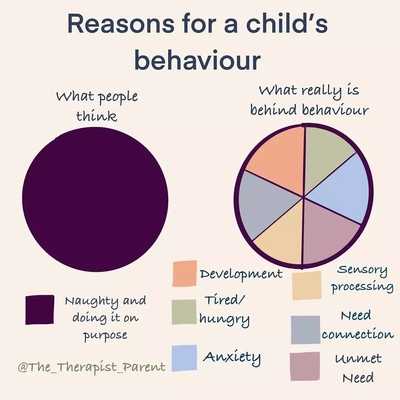
When a learner is having difficulties in your classroom – whether they’re not understanding the curriculum, their work is disorganised or forgetting instruction – our first instinct is often to see the behaviour as the problem. But behaviour is communication. It’s telling us something.
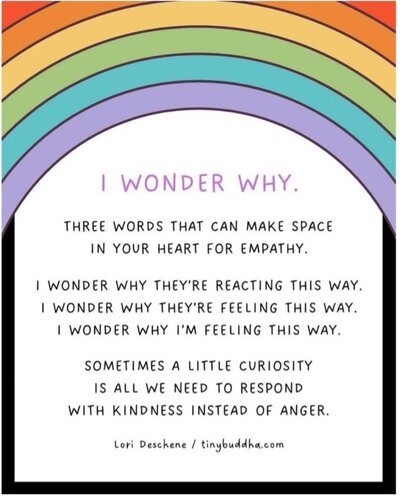
Before we label a child as ‘not trying hard enough’ or ‘being difficult’, we need to pause and ask: I wonder why?
A child who can’t sit still during a lesson is not ‘naughty’ – they might have a sensory need for movement. A child who ‘forgets’ instruction may have difficulties with working memory or might be anxious about getting it wrong. A child who refuses to start their work might not be lazy – but they may have difficulties in their executive functioning skills, or they might be overwhelmed and need connection and reassurance first.
When we shift from “what’s wrong with this child?” to “I wonder what they need right now?” we open space for empathy and understanding. This curiosity changes everything. It moves us away from punishment and consequences, towards responsive and inclusive teaching that actually addresses the root cause.
The behaviour we see is rarely the real issue. Our job is to look deeper, stay curious, and respond with kindness.
More from Amy's Inclusive Teaching series
Introduction to Inclusive Education for Learners with SEN
How to Support SEN – Communication and Interaction Needs
How to Support SEN – Cognition and Learning Differences
How to Support SEN – Understanding Sensory Needs
Supporting Learners with Social, Emotional and Mental Health Needs